Australia is not only a destination for travelers; it is a global powerhouse looking for the world’s brightest minds. As industries evolve and the economy grows, the Australian government actively seeks skilled professionals to address critical labor shortages. The Visa Kerja (Subkelas 482), officially known as the Temporary Skill Shortage (TSS) Visa, is the bridge that connects ambitious international talent with forward-thinking Australian employers.
If you are a professional looking to elevate your career, gain international experience, and potentially secure a permanent future in Australia, this visa is your ultimate tool. In this guide, we break down the complexities of sponsorship, eligibility, and career building under the Subclass 482 framework.
1. The Strategic Purpose of Subclass 482
As highlighted in our mission at AustralianVisaGov, the Subclass 482 visa is designed specifically for skilled professionals with company sponsorship. But why does this visa exist?
The Australian labor market often experiences “gaps”—situations where there aren’t enough local workers with specific technical skills to fill available roles. Whether it’s in healthcare, engineering, information technology, or niche trades, these shortages can slow down national growth. The Subclass 482 visa allows Australian businesses to recruit overseas talent to fill these positions, ensuring that the economy remains competitive and innovative.
2. Understanding the Three Primary Streams
The Subclass 482 visa is not a “one size fits all” document. It is divided into three distinct streams, depending on the type of occupation and the needs of the employer.
A. The Short-term Stream
This stream is for occupations listed on the Short-term Skilled Occupation List (STSOL). It is designed to fill temporary gaps where the shortage is expected to be resolved in the near future.
- Stay Period: Generally up to 2 years (or 4 years if an International Trade Obligation applies).
- Renewability: You can usually renew this visa once while in Australia.
B. The Medium-term Stream
This is the “Gold Standard” for many professionals. It covers occupations on the Medium and Long-term Strategic Skills List (MLTSSL) or the Regional Occupation List (ROL).
- Stay Period: Up to 4 years.
- The PR Pathway: This stream provides a clear pathway to Permanent Residency (PR) after a certain period of work with your sponsoring employer.
C. The Labor Agreement Stream
This is a more niche category. It occurs when an employer has entered into a formal “Labor Agreement” with the Australian government because they have specific needs that aren’t covered by the standard occupation lists (e.g., specialized sub-sectors in agriculture or meat processing).
3. The Foundation: Company Sponsorship
Unlike a Visitor Visa, you cannot simply apply for a 482 visa on your own. It is a three-stage process built on the foundation of Company Sponsorship.
Stage 1: Sponsorship Application
The company that wants to hire you must apply to become a Standard Business Sponsor. To do this, they must prove that their business is legally operating, financially viable, and committed to local labor market standards.
Stage 2: Nomination Application
Once approved as a sponsor, the company must “nominate” a specific position to be filled by an overseas worker. During this stage, the employer must undergo Labour Market Testing (LMT). They must prove that they tried to find an Australian worker for the role (usually by advertising for at least 4 weeks) but were unsuccessful.
Stage 3: Visa Application
This is your part. Once the nomination is approved, you apply for the visa itself. Your qualifications, work experience, and identity are checked to ensure you are the right person for the nominated role.
4. Eligibility: Do You Have What It Takes?
To be successful, you must meet rigorous professional and legal standards.
Work Experience Requirement
The Australian government requires that you have at least 2 years of relevant work experience in your nominated occupation. This experience should be full-time and completed within the last five years. It proves that you aren’t just a graduate, but a seasoned professional ready to contribute to the Australian workforce.
Skills Assessment
For certain occupations and nationalities, you may be required to undergo a formal Skills Assessment. This is a deep dive into your background by a relevant Australian authority (like Engineers Australia or the Australian Computer Society) to certify that your skills meet Australian standards.
English Proficiency
Communication is vital. You must prove your English language skills through approved tests like IELTS or PTE Academic. The required score varies depending on the stream, but generally, a “Competent” level of English is expected.
Health and Character
As with all Australian visas, you must meet the character requirements (police clearances from every country you’ve lived in for 12 months or more) and health requirements (medical examinations).
5. Financial Standards: TSMIT and Market Salary
Australia has strict laws to ensure that international workers are not exploited and that local wages aren’t driven down.
- TSMIT: Employers must pay at least the Temporary Skilled Migration Income Threshold (TSMIT). This is a minimum salary level set by the government.
- Annual Market Salary Rate (AMSR): The employer must prove they are paying you the same amount they would pay an Australian worker in the equivalent role. You will receive all the same benefits as a local worker, including superannuation (retirement savings) and leave entitlements.
6. Building a Long-Term Career
The Subclass 482 visa is often described as a “stepping stone.” While it is a temporary visa, it allows you to build a reputation within the Australian workforce.
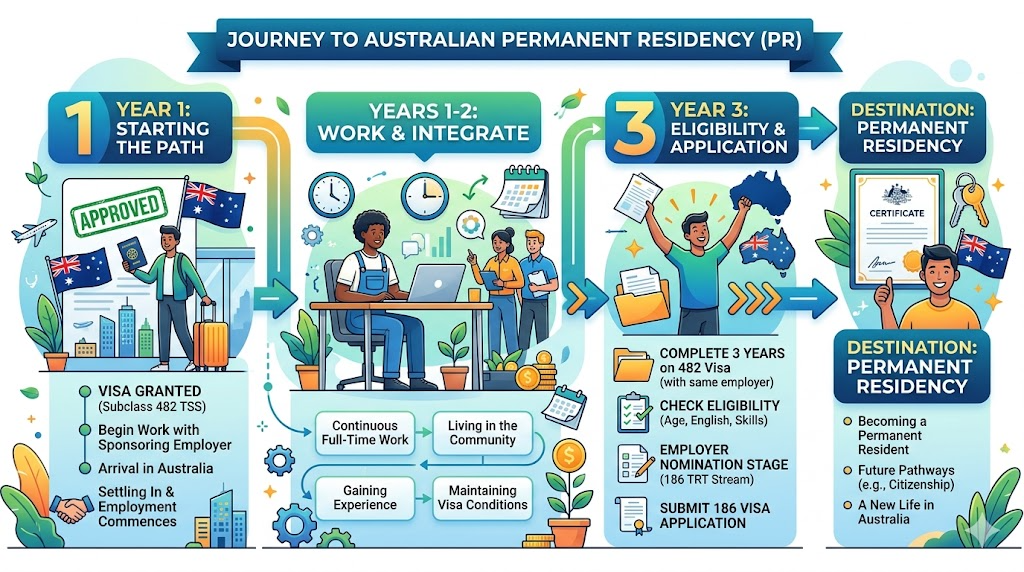
Many 482 visa holders eventually transition to permanent residency through the Employer Nomination Scheme (Subclass 186). After working for your sponsor for a set period (usually 2 to 3 years), your employer can nominate you for a permanent visa. This is the ultimate goal for many: transforming a temporary job into a permanent Australian life.
7. Obligations and Compliance: Maintaining Your Status
Integrity is a core value at AustralianVisaGov. Once you hold a 482 visa, you must adhere to several conditions to protect your status:
- Work for Your Sponsor: You are generally required to work only for the employer who sponsored you and only in the occupation for which you were nominated.
- Maintain Health Insurance: You are responsible for your own health costs in Australia. Maintaining “8501 Health Insurance” is a mandatory visa condition.
- Start Date: You must begin work within 90 days of arriving in Australia or 90 days of the visa grant if you are already in the country.
8. Step-by-Step Application Guide
- Find a Sponsor: Secure a job offer from an Australian company willing to sponsor you.
- Verify the Occupation: Ensure your job title is on the STSOL or MLTSSL.
- Prepare Documents: Gather your degree certificates, references, English test results, and passport scans.
- Sponsorship & Nomination: Wait for your employer to complete Stages 1 and 2.
- Lodge via ImmiAccount: Submit your Stage 3 visa application.
- Biometrics & Medicals: Complete these if requested.
- Visa Grant: Receive your digital visa and start your journey.
9. Expert Strategy: Why Applications Fail
Based on our insights into the Peraturan Migrasi 1994, here are common pitfalls to avoid:
- Inadequate Job Description: If the duties listed in the nomination don’t match the government’s definition for that occupation, the visa will be refused.
- LMT Failures: If the employer doesn’t advertise the job correctly before nominating you, the entire application will collapse.
- Experience Gaps: Ensure your CV clearly shows 2 years of post-qualification experience.
10. Your Professional Transformation
The Visa Kerja (Subkelas 482) is more than just a permit to work; it is an invitation to join one of the most stable and prosperous workforces in the world. It is an opportunity to solve real-world labor shortages, build an international network, and forge a career that knows no borders.
At AustralianVisaGov, we believe in the power of skilled migration. We are here to help you navigate the regulatory complexities and turn your professional expertise into an Australian success story. Are you ready to take the next step in your career?