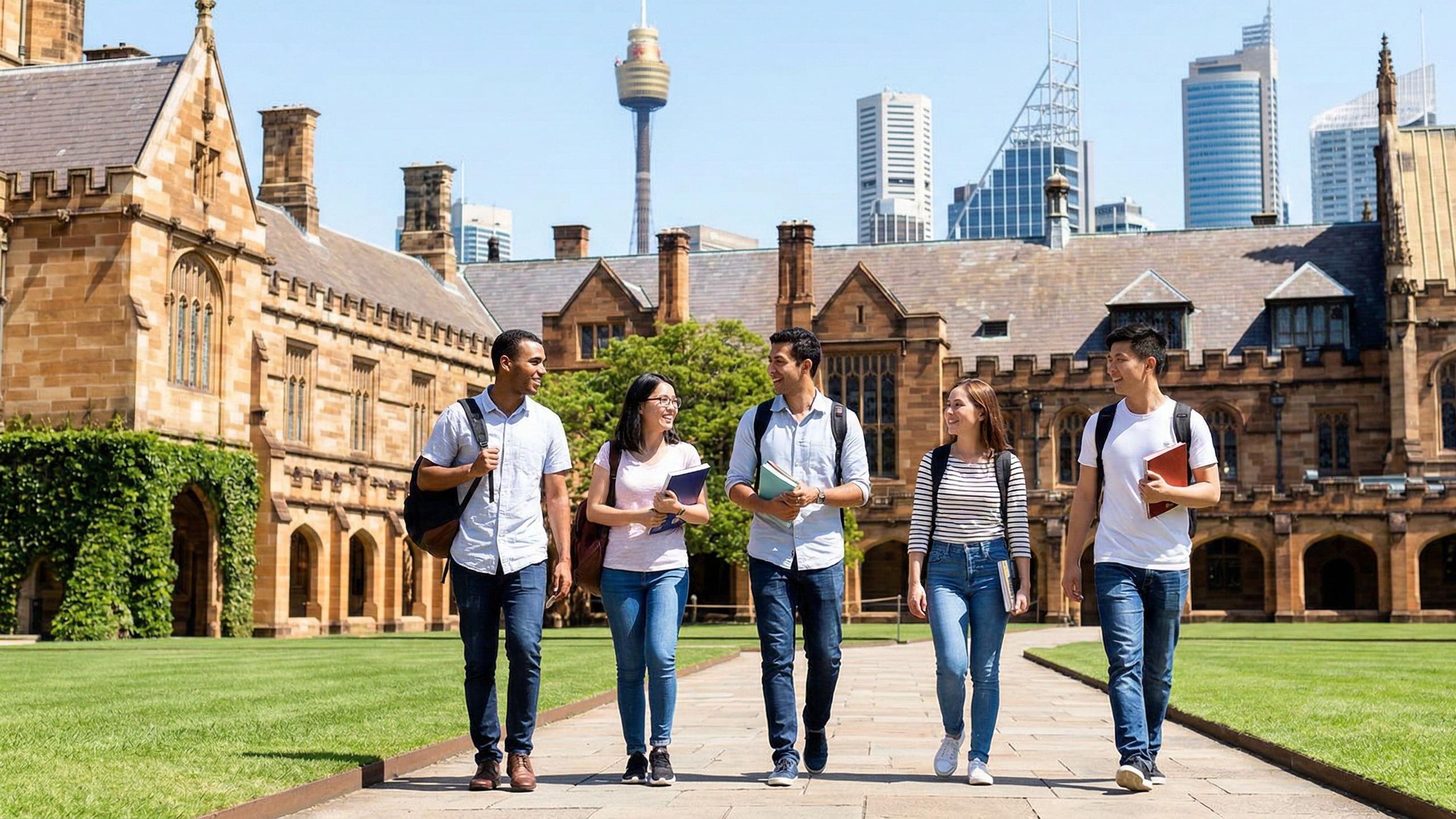
Australia has long been recognized as a premier destination for international education, offering world-class universities, cutting-edge research facilities, and a vibrant, multicultural lifestyle. However, securing the opportunity to study in the Land Down Under requires more than just an acceptance letter from an institution; it requires successfully navigating the Australian immigration system.
For international students, the gateway to this educational journey is the Visa Pelajar (Subkelas 500). In 2026, the Department of Home Affairs maintains a highly streamlined but rigorously enforced digital visa assessment framework. With the introduction of updated compliance measures and the permanent transition to the Genuine Student (GS) requirement, presenting a flawless, “Decision Ready” application is more critical than ever.
This comprehensive guide breaks down the essential requirements, conditions, and strategic steps international students must take to successfully secure their Subclass 500 visa in 2026.
1. Understanding the Subclass 500 Student Visa
The Subclass 500 visa is a temporary e-visa that allows international students to live, work, and study in Australia for the duration of their enrolled course. Unlike the older, fragmented visa system, the Subclass 500 is a universal visa category that covers all educational sectors, including:
- Higher Education (Bachelor, Master, PhD)
- Vocational Education and Training (VET)
- English Language Intensive Courses for Overseas Students (ELICOS)
- Primary and Secondary Schools
- Non-award courses
Key Privileges of the Visa:
- Duration: The visa is generally granted for the duration of your course, plus an additional one to two months, allowing you time to prepare for departure or apply for a subsequent visa (such as the Subclass 485 Temporary Graduate visa).
- Work Rights: As of the current 2026 regulations, international students are permitted to work up to 48 hours per fortnight while their course is in session, and unlimited hours during recognized holiday breaks.
- Family Inclusion: You can include eligible family members (a spouse, de facto partner, or dependent children) in your application, allowing them to accompany you to Australia.
2. The Primary Prerequisite: Confirmation of Enrolment (CoE)
Before you can even begin your visa application, you must be officially accepted into an Australian educational institution.
Your chosen course must be registered on the Commonwealth Register of Institutions and Courses for Overseas Students (CRICOS). Once you have received a formal Letter of Offer, accepted it, and paid the required tuition deposit, the institution will issue a Confirmation of Enrolment (CoE).
The CoE is a secure digital document containing a unique code. You must enter this code into your online visa application. Without a valid CoE, your Subclass 500 application cannot proceed.
(Note: There are rare exceptions to the CoE requirement, such as students sponsored by the Australian Department of Foreign Affairs and Trade, but these do not apply to the vast majority of applicants).
3. The Genuine Student (GS) Requirement
One of the most significant shifts in recent Australian immigration policy is the evolution of the integrity framework. The former Genuine Temporary Entrant (GTE) requirement has been replaced by the Genuine Student (GS) requirement.
The Department of Home Affairs uses the GS requirement to identify applicants whose primary intention is to obtain a quality education in Australia, rather than using the student visa scheme as a backdoor mechanism to acquire residency or work rights.
How to Satisfy the GS Requirement:
Instead of writing a lengthy, unstructured personal statement, the 2026 application incorporates targeted questions within the digital form. You must provide compelling evidence addressing:
- Your Current Circumstances: Your educational history, current employment, and reasons for choosing not to study in your home country (if a similar course is available).
- Ties to Your Home Country: Evidence of property, family ties, or prospective employment awaiting you upon your return.
- Course Value: How the specific course will benefit your future career trajectory and earning potential in your home country or a third country.
- Immigration History: A transparent record of your previous visa applications to Australia or other nations.
Providing generic, templated answers is a common trigger for automated scrutiny and subsequent refusal. Your GS responses must be highly personalized and supported by documentary evidence.
4. Financial Capacity Requirements
Studying in Australia requires a significant financial commitment. To protect international students from financial hardship and exploitation, the Australian government mandates that all applicants prove they have sufficient funds to cover their entire stay.
You must provide evidence that you can afford:
- Travel Costs: A return airfare to Australia.
- Living Costs: The Department updates the minimum living cost threshold annually. For 2026, applicants must demonstrate access to the current mandated baseline (e.g., approximately AUD 24,505 per year for the primary applicant, with additional funds required for an accompanying spouse or child).
- Tuition Fees: You must show funds to cover the remaining tuition fees for the first 12 months of your course.
Acceptable Evidence of Funds:
- Bank Statements: Official statements showing consistent deposits and a stable balance over several months. Sudden, unexplained “lump sum” deposits are highly suspicious and often lead to refusals.
- Evidence of Annual Income: Alternatively, you can provide official government tax documents demonstrating that your parents or your spouse have a personal annual income meeting the Department’s high threshold (usually upwards of AUD 80,000+).
- Government Loans or Scholarships: Official letters confirming the award of a recognized scholarship or educational loan.
5. English Language Proficiency
Australian educational institutions deliver their curriculum in English. Therefore, you must demonstrate that you possess the necessary linguistic skills to succeed in your studies and integrate into the community.
Unless you fall into an exempt category (e.g., you are a citizen of the UK, USA, Canada, NZ, or Ireland, or you have completed significant prior study in English), you must undertake an approved English language test.
Recognized Tests Include:
- IELTS (International English Language Testing System)
- PTE Academic (Pearson Test of English)
- TOEFL iBT
- Cambridge English: Advanced (CAE)
Required Scores: The required score depends heavily on your chosen course and whether you are packaging your main degree with an ELICOS (English language) program. Generally, a direct entry into a Bachelor’s or Master’s program requires an IELTS overall score of 6.0 to 6.5 (or equivalent). It is vital to check both your university’s specific requirements and the Department of Home Affairs’ minimum visa thresholds, as they can differ.
6. Health and Character Prerequisites
Australia places paramount importance on the health and safety of its community. Every Subclass 500 applicant must meet rigorous health and character standards.
Overseas Student Health Cover (OSHC)
You must purchase OSHC for yourself and any accompanying family members. This insurance must cover the entire duration of your visa, from the day you arrive until the day your visa expires. OSHC helps cover the costs of medical and hospital care while you are in Australia. Your educational provider can often arrange this on your behalf, or you can purchase it from an approved Australian health insurance provider.
Medical Examinations
Depending on your country of citizenship and your intended activities in Australia (such as studying in a healthcare setting), you will likely be required to undergo a medical examination. This must be conducted by a panel physician approved by the Australian government. Upon initiating your application, you will receive a Health Identifier (HAP ID) to book this appointment.
Character Clearances
You must be of good character to enter Australia. This generally means you must not have a substantial criminal record. You will be required to answer detailed character questions in your application and may be asked to provide police certificates from any country you have lived in for 12 months or more over the last 10 years.
7. Critical Visa Conditions
Securing the visa is only half the battle; maintaining it is equally important. The Subclass 500 visa comes with strict, legally binding conditions. Failure to comply can result in visa cancellation and a ban on future travel to Australia.
- Condition 8105 (Work Restrictions): You cannot work more than the allowed hours per fortnight while your course is in session.
- Condition 8202 (Academic Progress): You must remain enrolled in a registered course, maintain satisfactory attendance, and achieve acceptable academic progress as defined by your university.
- Condition 8501 (Health Insurance): You must maintain adequate OSHC for the entire duration of your stay.
- Condition 8533 (Notify Address): You must notify your educational institution of your residential address in Australia within 7 days of arriving, and update them if you move.
8. The Digital Application Process
In 2026, the entire visa application process is conducted online via the Department of Home Affairs’ ImmiAccount portal.
- Preparation: Gather all required documents, ensuring they are high-resolution color scans and accompanied by NAATI-certified translations if not in English.
- Creation: Create an ImmiAccount and select the Student Visa (Subclass 500) application form.
- Data Entry: Input your CoE codes, personal details, and comprehensive responses to the Genuine Student requirement.
- Upload Evidence: Attach your financial proof, English test results, OSHC certificate, and identity documents.
- Payment: Pay the non-refundable Visa Application Charge (VAC) via credit card or approved digital payment methods.
- Biometrics: If required, you will receive a notification to attend a local Biometric Collection Centre to provide your fingerprints and a digital photograph.
Processing times fluctuate based on the time of year and the sector you are applying for. By ensuring your application is “Decision Ready” with no missing documents, you bypass the manual “Request for Information” queue, resulting in significantly faster processing.
Charting Your Course to Success
The Australian Student Visa (Subclass 500) is the key to unlocking a world-class education and a transformative international experience. However, the 2026 digital assessment landscape is unforgiving of errors, omissions, or poorly articulated applications. Meeting the basic requirements is merely the baseline; demonstrating your genuine intent and precise compliance is what secures the final grant notice.
Ready to Secure Your Australian Student E-Visa?
Don’t let complex immigration requirements stand between you and your global education. At our professional visa agency, we specialize in comprehensive, end-to-end Australian e-visa processing.
Our experts meticulously audit your financial documents, refine your Genuine Student (GS) profile, and ensure your application meets the highest standards of the 2026 Department of Home Affairs framework. We transform overwhelming paperwork into a seamless, “Decision Ready” submission.
Professional Document Audits • Official 2026 Compliance • Fast-Track Digital Processing
Contact us now to register for your e-visa and take the first secure step toward your academic future in Australia.


Tinggalkan Balasan