What are the Australian Visa Fees in 2026? In 2026, the base Visa Application Charge (VAC) for Australia depends entirely on the visa subclass. A standard Visitor Visa (Subclass 600) typically costs AUD 195, while a Student Visa (Subclass 500) starts at AUD 715. For employment and residency pathways, a Working Holiday Visa (Subclass 417/462) costs AUD 650, and Skilled Migration Visas (Subclass 189/190) begin at AUD 4,640. It is crucial to note that these are base charges; your total migration budget must also account for secondary applicants, biometrics, health examinations, and mandatory card surcharges.
Navigating the financial requirements of the Australian immigration system requires meticulous planning. The Department of Home Affairs frequently updates its pricing structures, and failing to account for the total processing costs can lead to delayed lodgements or invalid applications.
This comprehensive guide breaks down the official 2026 fee schedule, highlights the hidden expenses applicants frequently overlook, and provides actionable insights to help you budget accurately for your Australian journey.
1. At a Glance: 2026 Base Visa Application Charges
The following table outlines the starting prices for the most commonly applied-for Australian e-visas in 2026. These figures represent the primary applicant cost when lodging an application online via ImmiAccount.
| Visa Category | Subclass | Base Application Charge (AUD) |
| Visitor (Tourist/Business) | Subclass 600 | From $195 (Outside Australia) |
| Electronic Travel Authority | Subclass 601 | $20 (Service Charge) |
| Visa Pelajar | Subclass 500 | From $715 |
| Temporary Graduate | Subclass 485 | From $1,895 |
| Working Holiday Maker | Subclass 417 / 462 | From $650 |
| Temporary Skill Shortage | Subclass 482 | From $1,455 to $3,035 |
| Skilled Independent | Subclass 189 | From $4,640 |
| Partner Visa (Provisional/Migrant) | Subclass 820 / 801 | From $8,850 |
Disclaimer: The Department of Home Affairs calculates fees in Australian Dollars (AUD). Exchange rates will dictate the final amount deducted from your local bank account.
2. Breakdown by Visa Category
Understanding the base fee is only the first step. If you are migrating with a spouse, de facto partner, or dependent children, the Department of Home Affairs implements a tiered pricing system for secondary applicants.
Visitor and Tourist Visas
The Subclass 600 Visitor visa is the standard entry route for tourism, visiting family, or short-term business activities.
- Primary Applicant: AUD 195.
- Onshore Applications: If you are already in Australia and applying for a further Subclass 600 visa to extend your stay, the fee is significantly higher, starting at AUD 475.
- Subsequent Temporary Application Charge (STAC): Applying for a second temporary visa while onshore may attract a STAC of AUD 700 on top of the base fee.
Student and Education Pathways
Australia’s booming international education sector is heavily regulated. The financial commitment extends beyond university tuition.
- Primary Applicant (Subclass 500): AUD 715.
- Secondary Applicant (18 and over): AUD 535. This applies to spouses or de facto partners accompanying the student.
- Secondary Applicant (Under 18): AUD 175 per child.
Working Holiday Maker Program
For young adults seeking cultural exchange and temporary work, the WHM program is highly accessible but requires strict financial proof.
- Subclass 417 and 462: The standard application charge is AUD 650.
- Note: There are no secondary applicant fees here, as dependents cannot be included on a Working Holiday Visa.
Skilled Migration and Employer-Sponsored Visas
Permanent residency and long-term work visas carry the most substantial financial investments.
- Skilled Independent (Subclass 189): The base charge is AUD 4,640. However, adding an adult dependent (partner) costs an additional AUD 2,320, and adding a child costs AUD 1,160.
- Second Instalment Provision: If your dependent partner (over 18) does not possess “Functional English,” you will be required to pay a second instalment charge of AUD 4,890 before the visa can be granted. This covers the cost of government-provided English language tuition upon arrival.
3. The “Hidden” Costs: Budgeting Beyond the Base Fee
A common pitfall for many applicants is assuming the Visa Application Charge (VAC) is the only expense. In our professional experience, the auxiliary costs of assembling a “Decision Ready” application can sometimes rival the base fee itself. To build an accurate migration budget, you must account for the following:
A. Health Examinations (Panel Physicians)
Almost all long-term visas—and many short-term visas, depending on your country of citizenship—require a comprehensive medical clearance.
- You cannot use your local doctor. You must book an appointment with a Bupa-approved or government-approved Panel Physician.
- Estimated Cost: AUD 300 to AUD 500, depending on your location and the specific tests required (e.g., chest x-rays for tuberculosis, blood tests for healthcare workers).
B. Biometric Data Collection
If you are applying from a biometric-collection country, you will receive a request to provide your fingerprints and a digital photograph at an Australian Biometric Collection Centre (ABCC) or VFS Global office.
- Estimated Cost: AUD 40 to AUD 80, payable directly to the collection center, not the Australian government.
C. Character Clearances (Police Checks)
You must prove you are of good character. This requires obtaining an official police certificate from every country you have lived in for 12 months or more over the past 10 years.
- Estimated Cost: Varies wildly by country. An Australian Federal Police (AFP) check costs approximately AUD 45, whereas international checks can range from AUD 20 to AUD 150 each.
D. Document Translation and Certification
The Department of Home Affairs mandates that all non-English documents (birth certificates, bank statements, employment letters) be translated by an accredited professional (such as a NAATI-certified translator in Australia).
- Estimated Cost: Translators typically charge per page or per word. Budget roughly AUD 40 to AUD 80 per document.
E. Mandatory Health Insurance
You cannot hold a student or temporary graduate visa without maintaining strict health coverage.
- Student Visa (OSHC): Overseas Student Health Cover must be paid upfront for the entire duration of your course. This can range from AUD 500 to AUD 700 per year for a single applicant.
- Graduate/Working Visas (OVHC): Overseas Visitor Health Cover is paid monthly, usually starting around AUD 60 to AUD 150 per month.
4. Payment Methods and Surcharges in ImmiAccount
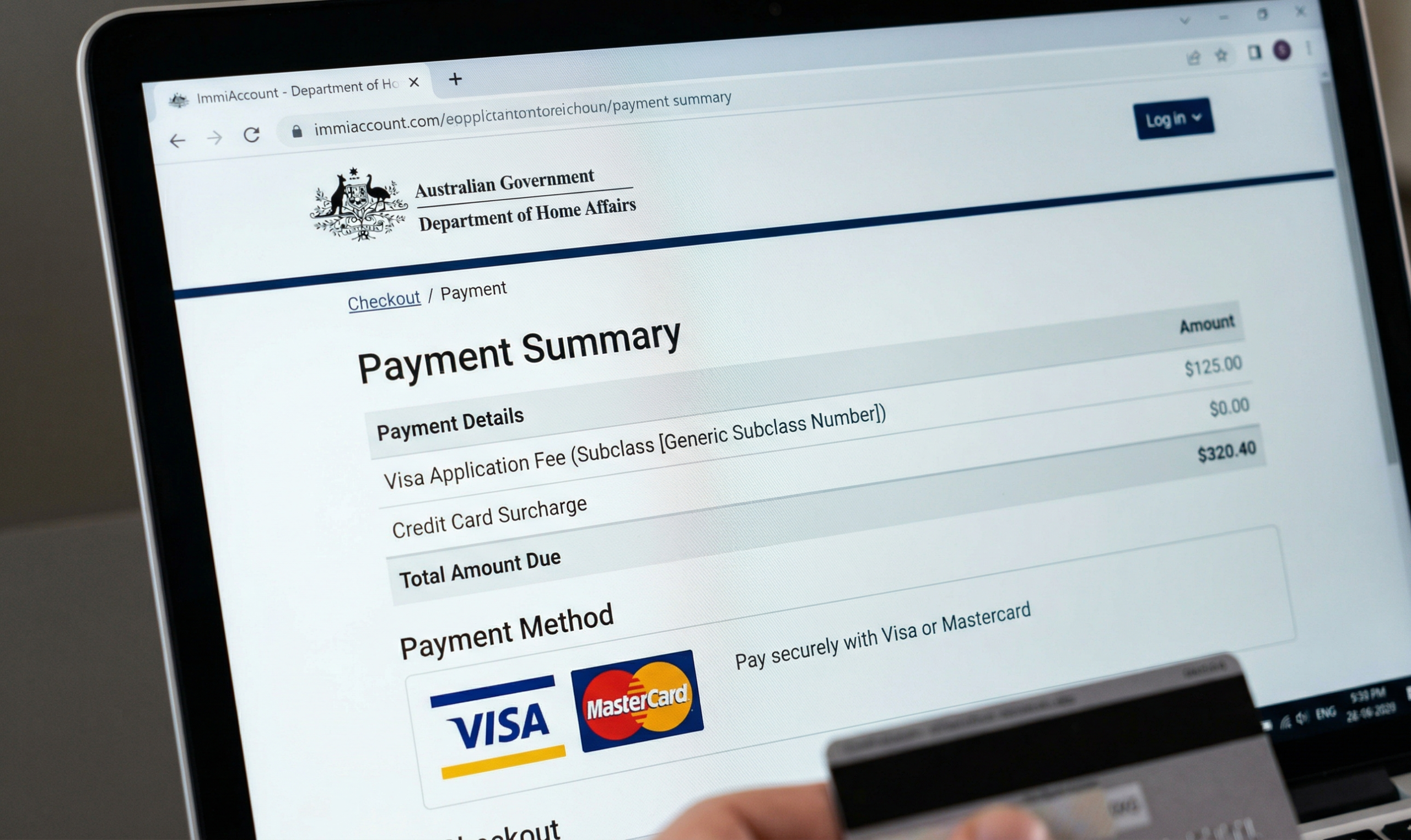
In 2026, the migration system is entirely digitized. All payments are processed through the secure ImmiAccount portal at the time of lodgement. It is vital to ensure your bank account has sufficient funds not just for the visa fee, but for the international transaction fees and mandatory card surcharges.
The Australian government passes merchant fees directly to the applicant. The current surcharge rates are:
- Mastercard (Debit/Credit): 1.40%
- Visa (Debit/Credit): 1.40%
- American Express (AMEX): 1.40%
- PayPal: 1.01%
- UnionPay: 1.90%
Expert Advice: If you are paying for a highly expensive visa, such as a Partner Visa (AUD 8,850), a 1.40% credit card surcharge adds an extra AUD 123.90 to your total cost. Ensure your card’s daily transaction limit is raised to accommodate the full amount, as a declined payment will prevent your application from being submitted.
5. Refund Policies: What Happens if You Are Refused?
A critical reality of the Australian migration system is that the Visa Application Charge is generally non-refundable.
If your application is refused due to missing documents, failure to meet the Genuine Temporary Entrant (GTE) or Genuine Student (GS) criteria, or character grounds, the Department will not return your money. Refunds are only issued in highly exceptional, legally defined circumstances (such as the primary applicant passing away before a decision is made, or a systemic error in the ImmiAccount portal).
This strict policy highlights the immense importance of getting your application right the first time. Submitting an incomplete file is a highly expensive mistake.
Conclusion: Precision is Your Best Investment
Understanding the 2026 Australian visa fees requires looking far beyond the headline numbers on the government website. By calculating the base charges, the secondary applicant tiers, the card surcharges, and the mandatory auxiliary costs (health, biometrics, translations), you can create a realistic and stress-free migration budget.
Because the stakes are financially high and the fees are non-refundable, professional oversight is not just an added luxury—it is a strategic investment to protect your funds and secure your travel goals.
Don’t Risk Your Visa Investment—Apply with Confidence
Navigating the financial and documentary complexities of the Australian immigration system can be daunting. One missing translated document or an incorrectly calculated fee can result in a costly refusal.
At our agency, we provide end-to-end e-visa processing and professional document auditing. We ensure that your application is 100% “Decision Ready,” maximizing your chances of approval and protecting your financial investment. From calculating your exact fee structure to organizing your biometric appointments, we handle the intricacies so you can focus on your journey.

Tinggalkan Balasan